



Why Is My Chesapeake Yard Full of Mosquitoes?
Chesapeake sits in one of the most mosquito-friendly stretches of Virginia. The Elizabeth River tributaries, the slow-draining terrain around the Dismal Swamp corridor, and the flat, low-lying neighborhoods that make up most of South Chesapeake all create conditions mosquitoes thrive in. Add the coastal humidity that settles over Hampton Roads from June through September and rarely breaks at night, and you have a climate that extends mosquito activity well beyond what most people expect.
Even a clean, well-kept yard can become uncomfortable by late afternoon. If you’re wondering how to get rid of mosquitoes in your yard and nothing seems to work, something specific is driving the pressure, and in most cases the source is right there on the lot. Some of it is fixable over a weekend. Some of it won’t get better without a real treatment plan.
What Draws Mosquitoes to Your Yard
Two things make Chesapeake yards particularly bad in summer: the amount of standing water the terrain holds after rain, and the coastal humidity that keeps mosquitoes active far later into the evening than most people expect.
The Standing Water Problem
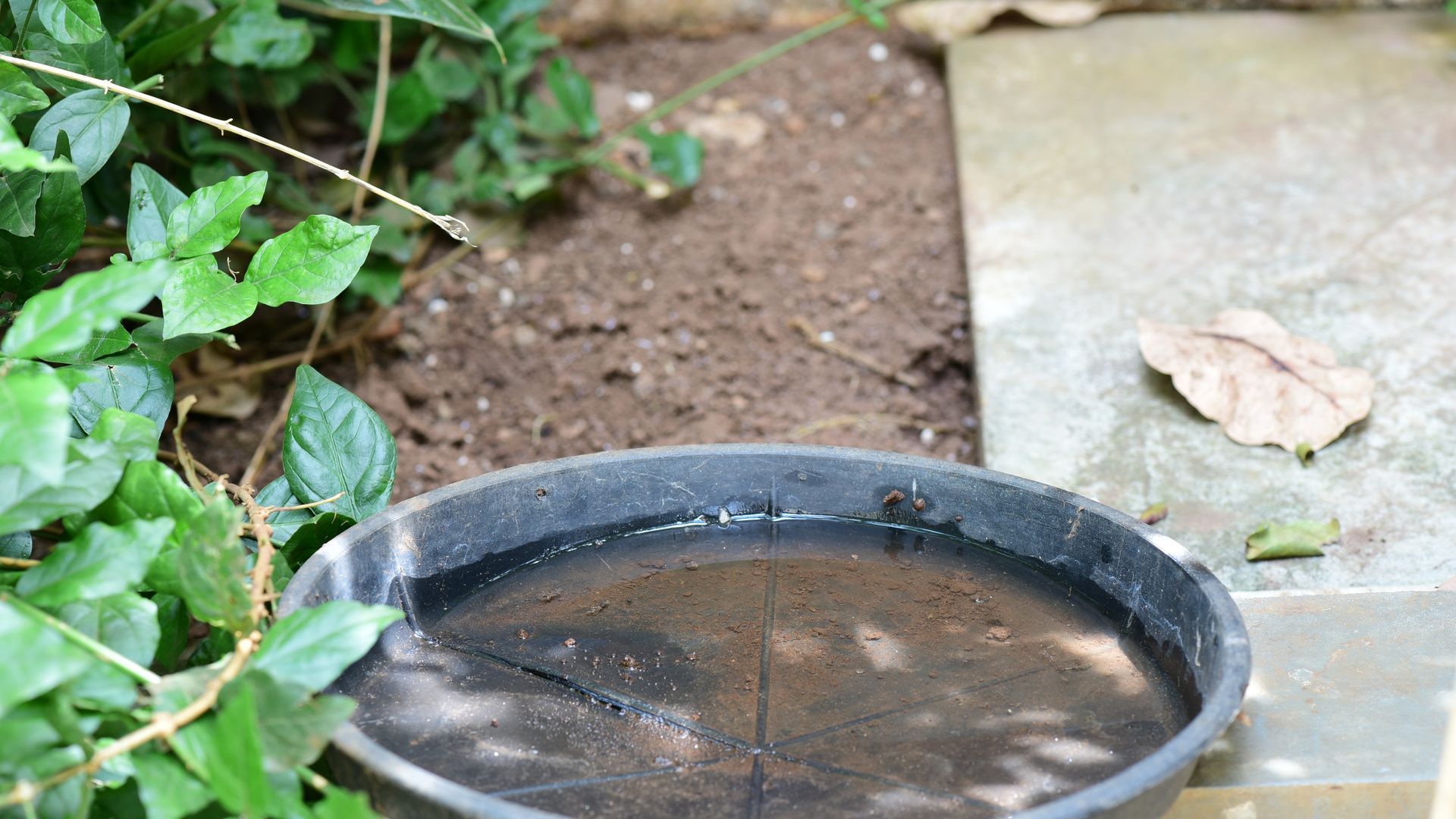
Mosquitoes don’t travel far from where they breed. A female needs roughly a week of still, shallow water to complete her cycle from egg to adult, and Chesapeake’s low-drainage terrain gives her plenty of options. Most breeding happens in water sources homeowners checked once in May and forgot about.
Common spots where they breed:
- Birdbaths that haven’t been emptied or scrubbed in more than a few days
- Gutters backed up with leaf debris and holding water against the roofline
- The saucer under a patio planter that refills with every rain
- Low patches of lawn where water settles for three or four days after a storm
Any one of these can produce hundreds of mosquitoes in a week. Several together can make a backyard feel impossible.
The coastal humidity here extends active hours in ways that catch people off guard. In drier parts of Virginia, adult mosquitoes lose moisture quickly in the heat and pull back earlier in the evening. Hampton Roads air stays damp enough through summer that they remain active longer after dark and get going earlier in the morning. The comfortable temperature range for mosquito activity runs from about 50 to 95 degrees; our evenings rarely push them out of that window.
Dense vegetation compounds the problem. Mosquitoes rest in shaded, sheltered spots during peak afternoon heat: underneath shrubs along fence lines, in thick groundcover at the base of trees, anywhere that’s leafy and undisturbed. Those are the staging areas before they come after you at dusk.
How to Get Rid of Mosquitoes in Your Yard
Some of the most effective steps don't require any products at all. The goal is removing what's giving mosquitoes a breeding site or a place to rest within reach of your yard.
What Homeowners Can Do First
Walk your property with one question in mind: where is water sitting still for more than two or three days? You’re also looking for vegetation dense enough to give mosquitoes shaded resting cover. Most people find three to five problem areas on the first pass, and addressing them makes a noticeable difference.
Practical starting steps for mosquito control in Chesapeake and the surrounding area:
- Scrub birdbaths every few days, not just refill them; eggs adhere to the container walls and won’t rinse off with water alone
- If your gutters back up every season, adding a guard removes one of the most consistent breeding sites on the property
- Drain and store anything in the yard that catches rainwater: old buckets, tarps, toys, wheelbarrows, overturned lids
- Cut back vegetation along fence lines and under trees to remove the daytime resting cover mosquitoes rely on
For ponds or water features you want to keep, mosquito dunks (Bacillus thuringiensis israelensis, or Bti) dissolve slowly in standing water and kill larvae without affecting fish, birds, or pets. They’re available at most hardware stores and work well in rain barrels and decorative water features.
There’s a realistic ceiling on all of this. Mosquitoes cover 100 to 300 yards in their lifetime, so they don’t need to breed in your yard to bite you in it. If you’re surrounded by low-drainage land, a neglected neighboring property, or tidal wetlands within flight range, addressing your own yard reduces pressure but won’t eliminate it. Skip the yard work and the pressure only gets worse. Just don’t expect it to disappear entirely.
When DIY Treatments Fall Short
Yard work reduces the problem on your own property. It doesn't address breeding happening outside your lot, and it doesn't treat the mosquitoes already active in your yard.
What Professional Mosquito Control Does
If the obvious water sources are gone and the pressure is still bad, the remaining breeding is probably coming from somewhere harder to access: a drainage strip along the property edge, a low corner that stays damp through most of the summer, or tidal areas within flight range that no amount of yard work addresses. That’s where professional mosquito control in Chesapeake makes a meaningful difference.
We treat properties with a combination of barrier spray and larvicide, a product applied directly to standing water that kills mosquito larvae before they hatch. The barrier spray goes on foliage around the yard’s perimeter, along fence lines, and into the shaded resting zones where adults wait out the heat. It addresses what’s active now and keeps working for three to four weeks per application. We’re treating the areas mosquitoes actually use, not just running a general perimeter pass.
For standing water that can’t be drained, we apply larvicide directly to it. On properties close to tidal areas or with drainage problems that aren’t fixable, we also use In2Care mosquito traps. The traps attract egg-laying females, coat them with a slow-acting larvae killer and a natural fungal treatment, then release them. Those females carry the treatment back to other water sources and pass it to other mosquitoes they contact. For tidewater environments where water management alone falls short, In2Care is one of the more effective tools available.
Monthly service from May through October keeps that treatment coverage consistent. A single application holds for about three to four weeks when conditions cooperate; Chesapeake’s rainfall and humidity shorten that window, and a gap in coverage shows up quickly in how comfortable your yard feels. The difference between a one-time spray and monthly service is noticeable by the end of the first summer.
Mosquito season in Hampton Roads starts in May and runs into October. If you’re losing your backyard to it, call us at (757) 420-4800 or visit our mosquito control page to set up a free inspection. We’ll assess what’s driving the pressure on your specific property and build a treatment plan around it.
We serve homeowners across Hampton Roads, including:
- Chesapeake, VA
- Virginia Beach, VA
- Norfolk, VA
- Suffolk, VA
- Portsmouth, VA
- Hampton, VA
- Newport News, VA
- Poquoson, VA
- Smithfield, VA
- Gloucester, VA